
Enterprise Architecture
Department isolation with controlled cross-access — built on deterministic storage and coordinate addressing.
Department Isolation
Each department operates in its own independent BASE, ensuring strict physical separation.
Controlled Cross-Access
Cross-department execution is explicitly authorized and routed through ACL enforcement.
Versionable Data
BASE files remain deterministic text structures, enabling native Git diffs, review and rollback.
1. Department-Based Storage Model
In a traditional monolithic database, departments share a single schema and storage engine. APIBASE replaces this model with independent bases:
/data/users/finance/finance.php
/data/users/hr/hr.php
/data/users/inventory/inventory.php
/data/users/production/production.php
/data/users/maintenance/maintenance.php
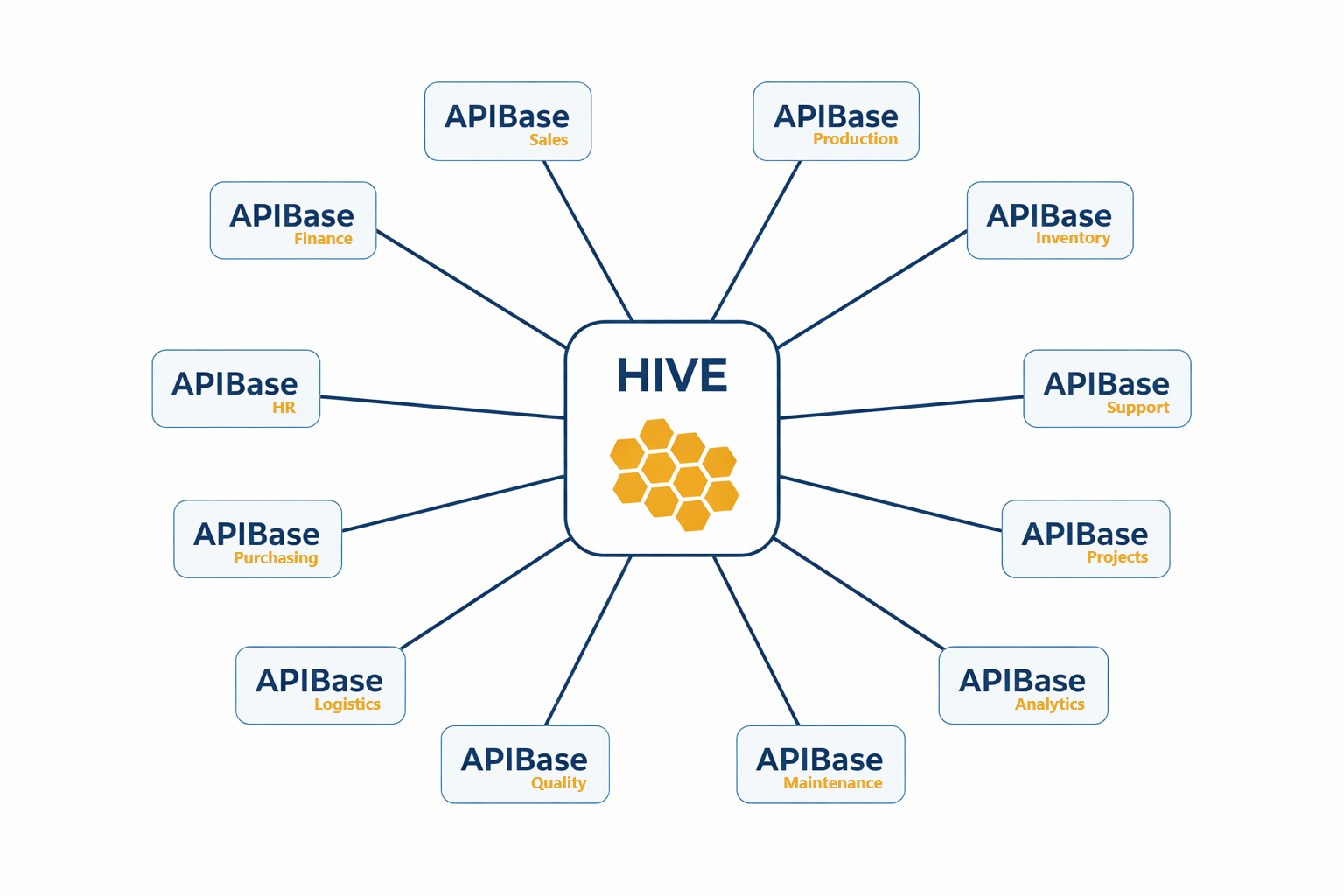
2. Hive Gateway & Cross-Base Routing
Each department runs its own BASE while the Hive controls cross-base communication and permissions.
3. Execution Pipeline
HTTP Request
      ↓
Bearer Token Validation
      ↓
Context Resolution
      ↓
ACL Evaluation
      ↓
Base Selection
      ↓
Deterministic Execution
      ↓
Structured JSON Response
4. Context Model
- User — personal base
- Hive — authorized cross-base access
- System — internal metadata control
The context determines which base the engine is allowed to access. No implicit fallback is assumed.
5. Access Control Layer
APIBASE separates authentication from authorization. Permissions are explicit and centrally managed.
Token → apitokens
         ↓
       hiveacls
         ↓
       hivebases
5.1 Service Users & Hive ACL
In APIBASE, a department base is implemented as a regular user account. For example, inventory is a real user that can log in, manage tables, and operate like any standard BASE owner.
Token scopes
- scope=full — personal API (read/write) on the token owner’s BASE via
/api/* - scope=hive — gateway token (read-only today) to access shared department BASEs via
/hive/get/<basekey>/*
Hive authorization chain
curl https://apibase.work/hive/get/inventaire/T2/L1?format=assoc \
  -H "Authorization: Bearer YOUR_HIVE_TOKEN"
curl https://apibase.work/hive/get/inventaire/T2/L1/C2?format=raw \
  -H "Authorization: Bearer YOUR_HIVE_TOKEN"
apitokens (scope=hive) → hiveacls → hivebases (basekey → username)
This model creates a clean separation:
- Ownership: the service user (inventory) controls its BASE directly.
- Collaboration: department members access the BASE through HIVE with scoped tokens and ACL.
6. Data Address Protocol
Traditional databases retrieve data through query languages. APIBASE addresses data directly through coordinates.
BASE / TABLE / LINE / COLUMN
Example request:
GET /hive/get/inventory/T4/L2/C2
Deterministic lookup:
$data[4][2][2]
7. Operational Resilience
- If one department fails, others remain operational
- No shared schema corruption risk
- No global locking side effects
- No cascading transactional failure
8. Versionable BASE Files
APIBASE stores data as deterministic text files. This allows native integration with version control systems.
- Cell-level Git diffs
- Branching for data changes
- Rollback without SQL dumps
- $data[4][12][2] = 'Alice'
+ $data[4][12][2] = 'Alicia'
9. Distributed BASE Network
Through HIVE, multiple BASEs can form a distributed data network. Each BASE remains independent while accessible through a unified coordinate protocol.
          Client
            │
        Hive Gateway
       ┌─────┴─────┐
       │           │
Inventory Base   Finance Base
 Server A         Server B
- Independent data ownership
- Controlled cross-access
- Unified protocol
10. Comparison with Traditional Architecture
| Traditional Monolith | APIBASE 5.0 |
|---|---|
| Single shared database | Base per department |
| Schema coupling | Physical isolation |
| Global failure risk | Localized failure impact |
| Complex permission layers | Deterministic ACL routing |
| Binary storage engines | Versionable BASE files |
11. Strategic Value
- Improved operational resilience
- Simplified governance
- Reduced blast radius
- Predictable execution model
- Git-compatible data infrastructure
- Distributed BASE network capability